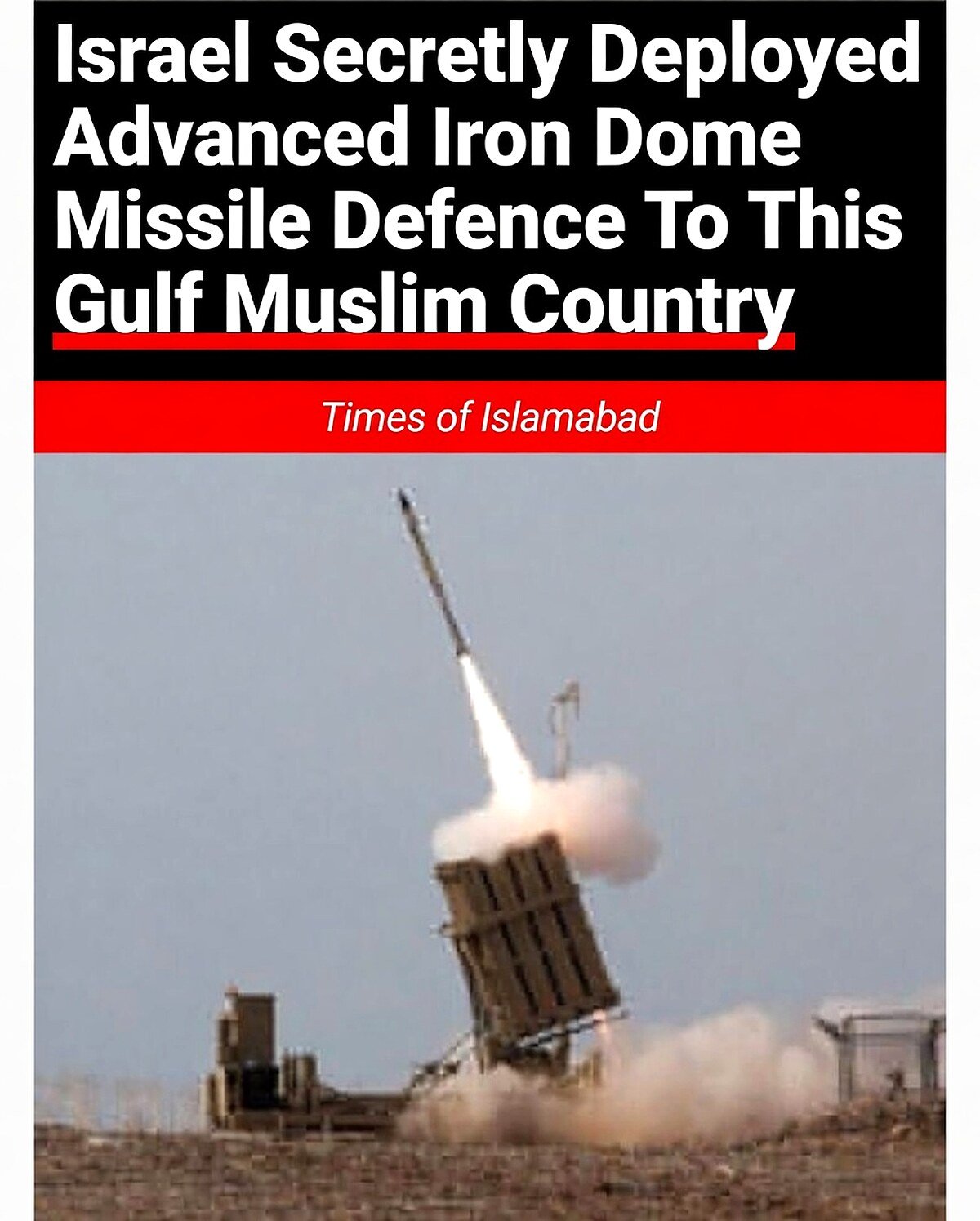




ISLAMABAD: A quiet military move at the start of a regional conflict is now raising serious questions about how far the crisis in the Middle East has already spread.
When tensions between and escalated into open confrontation, an unexpected development reportedly unfolded behind the scenes.
According to reports, Israel quietly transferred one of its most advanced air defense systems—the —to the , along with trained personnel to operate it.
But that’s not the full story…
A Strategic Deployment Few Saw Coming
The Iron Dome is widely known for its battlefield success, boasting interception rates often cited above 85–90% against short-range threats.
Its deployment inside the UAE signals more than just defense—it reflects a shift in how regional alliances are being operationalized during conflict.
This is where things get interesting…
Unlike previous conflicts where Israel largely operated within its own borders, this move indicates forward deployment into allied territory, potentially expanding its defensive perimeter hundreds of kilometers beyond its homeland.
And this raises an important question…
Was this purely defensive, or part of a broader coordinated strategy?
Why the UAE Matters in This Equation
The UAE sits at a critical geographic and economic crossroads, hosting key infrastructure, oil facilities, and international trade routes.
With Iran’s missile and drone capabilities expanding rapidly, Gulf nations have become increasingly vulnerable to long-range precision strikes.
What’s more concerning is…
Recent years have seen a sharp rise in drone warfare and ballistic missile proliferation across the region, with systems capable of bypassing traditional defenses.
By deploying Iron Dome, Israel may be attempting to counter not just immediate threats, but also emerging asymmetric warfare tactics.
However, a deeper issue is emerging…
A Signal of Expanding Military Cooperation
The reported presence of Israeli soldiers operating the system inside the UAE highlights a level of military cooperation that would have been unthinkable just a decade ago.
Following normalization agreements in recent years, intelligence sharing and defense coordination have quietly expanded.
But this move takes it a step further—placing Israeli boots on the ground in a Gulf state during an active conflict scenario.
And that changes the equation significantly.
This is where things get even more complex…
The Hidden Message to Iran
Military analysts suggest that this deployment sends a dual message to Iran.
First, it demonstrates that Israel’s defensive reach is no longer limited to its own borders.
Second, it signals that any escalation could trigger a broader regional response involving multiple aligned states.
However, there is another layer to this strategy…
Iron Dome is primarily designed for short-range threats, meaning its placement in the UAE suggests anticipation of specific types of attacks—possibly drones or low-altitude projectiles rather than long-range ballistic missiles.
So why this system—and why now?
Mid-Conflict Twist: Defensive or Deterrence?
Around this point, a new perspective begins to emerge.
Rather than simply protecting the UAE, the deployment could be aimed at shaping battlefield dynamics by reducing Iran’s ability to exert pressure through proxy or indirect attacks.
This introduces a strategic twist…
By neutralizing low-cost aerial threats, Iron Dome potentially disrupts one of Iran’s most effective asymmetric tools.
And that could force a recalibration of tactics on all sides.
But that’s not the only implication…
Risks of Escalation Grow
While the move enhances defense, it also increases the risk of escalation.
The presence of Israeli-operated systems in the UAE could be perceived as direct involvement in the conflict, even if framed as defensive.
This raises another important question…
Could this trigger retaliatory measures targeting not just Israel, but its regional partners as well?
History suggests that such deployments often blur the line between defense and active participation.
And in volatile regions, perception can be just as powerful as reality.
What Happens Next?
As the situation continues to unfold, the implications of this deployment are likely to ripple across the region.
Will other Gulf nations seek similar defense arrangements?
Could this lead to a more formalized regional air defense network?
Or does it risk drawing more countries into an already complex conflict?
One thing is clear…
The quiet arrival of Iron Dome in the UAE may be just the beginning of a much larger shift in Middle Eastern security dynamics.
And the real impact of this move might only become visible when the next phase of the conflict begins.